
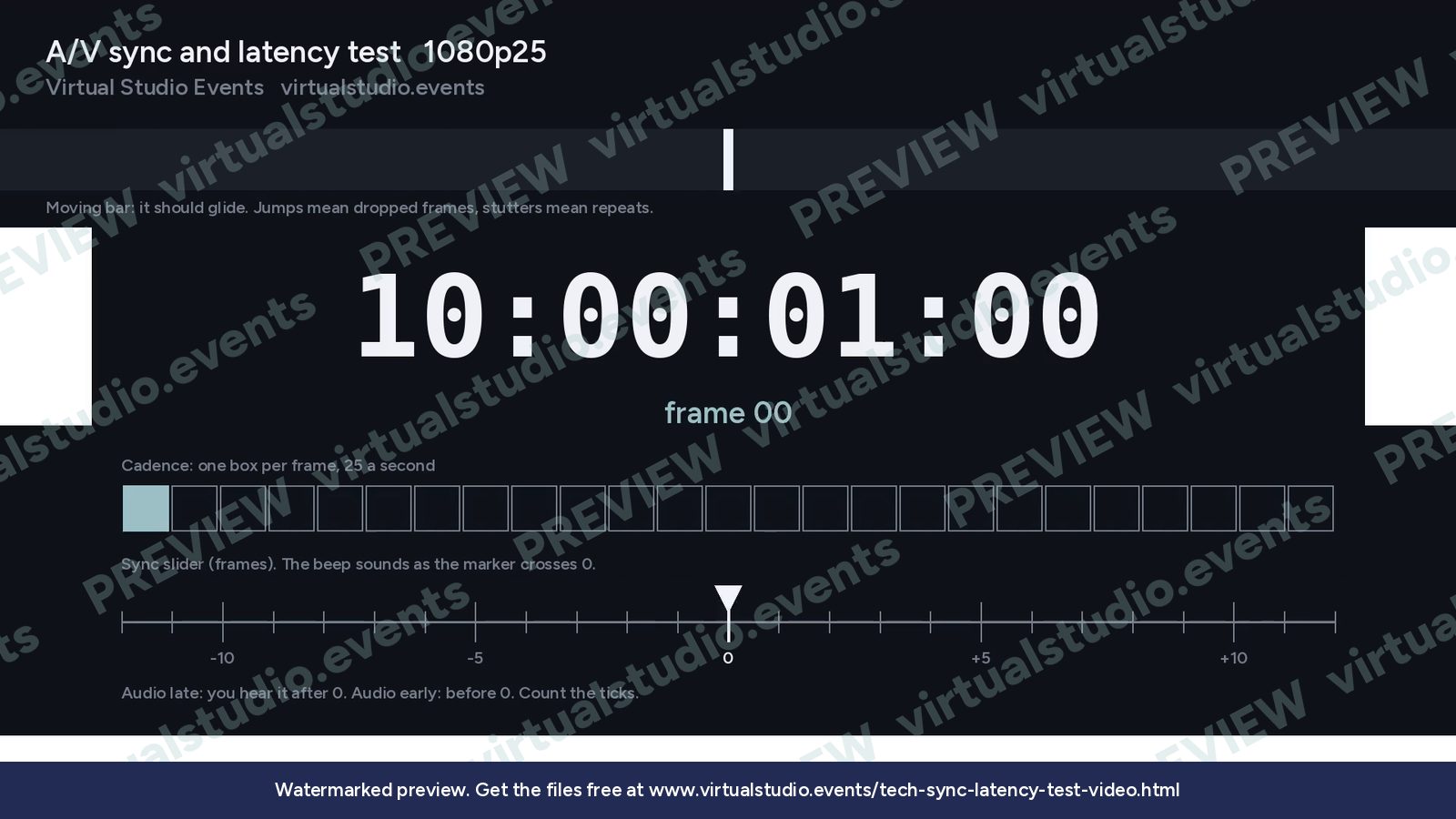
Lip sync drifts somewhere in most event chains: through a scaler, a capture card, an encoder or a remote contributor's laptop. These four MP4s make it measurable. Each second, a one-frame white flash and a one-frame 1 kHz beep land on frame 00, a marker crosses zero on a slider marked in frames, and a bar sweeps across the top at constant speed so dropped or repeated frames show as jumps.
What it measures
- Lip sync: record the far end and step through it. The flash and the start of the beep should be on the same frame; the slider tells you how many frames out you are.
- Glass-to-glass latency: put the source monitor and the viewer's screen in one photo and subtract the burnt-in timecodes.
- Dropped frames: the moving bar should glide; jumps and stutters show where frames go missing.
Get the files
The preview is free to look at. For the clean files, put your email in and we'll send a download link straight away.
Formats
1080p25 and 1080p50 for UK shows, 1080p29.97 with drop-frame timecode for US-standard shows, and 2160p25 for UHD chains. All are H.264 with AAC at 48 kHz, Rec. 709, 60 seconds long and safe to loop.
Sync problems often start with the encoder or the platform. The streaming platform settings sheet lists what each platform expects.
Rather we did the paperwork?
Send the client brief and floorplan to Production Office and get back the kit list, signal flow, crew plan and schedule, checked by a broadcast engineer, with nothing of ours on it.